



The Canadian CPA Profession has released the exam blueprints for the new CPA Professional Program, providing a much clearer picture of how candidates will be assessed for each exam.
The new program includes four main examination stages: Foundational Development, CPA Core, CPA Leadership, and CPA Professional Readiness. A Knowledge Assessment is also available for candidates who need to demonstrate prerequisite knowledge before entering the program.
Here’s what the new blueprints tell us.
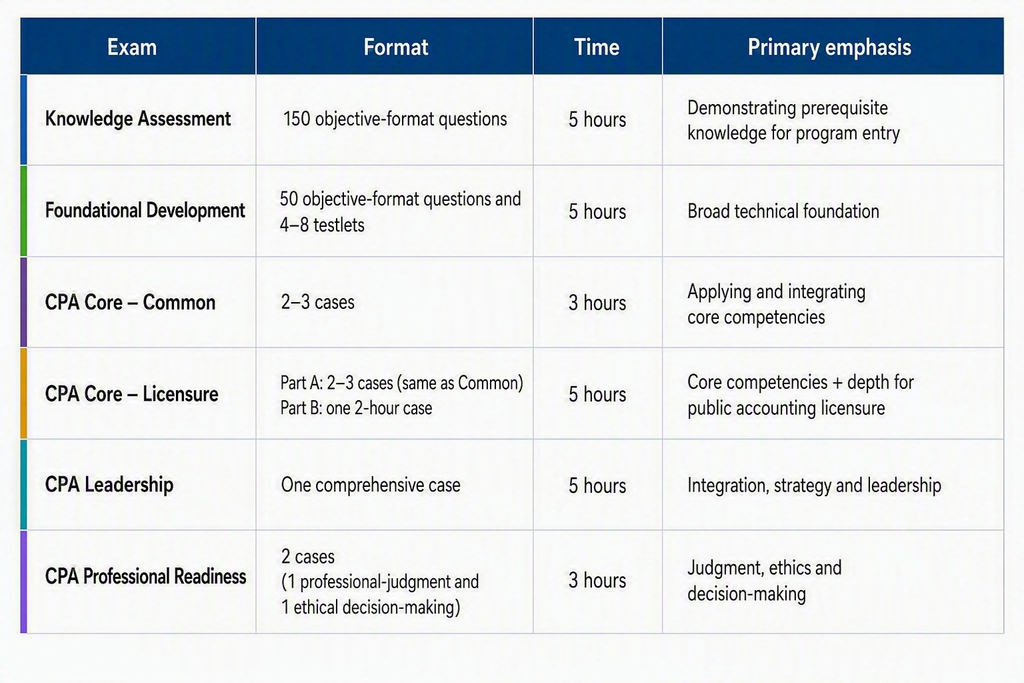
At a Glance: The New CPA Exams
Knowledge Assessment: An Alternate Route into the Program
The Knowledge Assessment is an optional entrance exam for candidates who do not otherwise meet the CPA Professional Program’s entrance requirements. They must demonstrate that they have the prerequisite knowledge and competencies needed to succeed in the program.
The five-hour exam consists of 150 objective-format questions and is divided into two controlled parts. Part A includes 90 questions over three hours and assesses a broad range of topic areas, while Part B includes 60 questions over two hours, split equally between Financial Reporting (50%) and Management Decision-Making and Information (Data) Systems/Technology (50%). Candidates will not have access to reference materials during the Knowledge Assessment.
Candidates must achieve sufficiency in Financial Reporting and Management Decision-Making and Information (Data) Systems/Technology, as well as sufficiency on the exam overall.
Foundational Development: Breadth Before Depth
In the Foundational Development Exam, candidates will answer 50 objective-format questions (33% of the exam marks) and 4–8 scenario-based testlets (67% of the exam marks). Testlets share a common scenario and are designed to take between 20 and 60 minutes each.
This exam establishes the technical and analytical base candidates will need before moving into increasingly case-driven assessments, and the content covered is broad. The largest allocation goes to Management Decision-Making and Information (Data) Systems/Technology at 15%–25%, followed by Financial Reporting at 10%–20%. Most other competencies fall within 5%–15% ranges.
CPA Core: Applying Technical Knowledge
CPA Core introduces two pathways: Common and Licensure.
The Common Exam is three hours and consists of two to three cases, 60–120 minutes each. Cases involve non-complex situations with some competency integration and clear direction for the requirements. These cases are not intended to be time pressured.
Candidates pursuing public accounting licensure must also write the CPA Core – Licensure Exam. Part A contains the same cases as the Common Exam, while Part B adds a two-hour licensure-focused case. Candidates must demonstrate sufficient depth of knowledge and skills in licensure-specific situations to satisfy the pre-certification licensure requirement.
Part A places the greatest emphasis on Assurance and Trust (20%–35%) and Financial Reporting (20%–35%), followed by Tax (10%–25%). Then, Part B increases the potential weighting of Assurance and Trust to 30%–50%, with Financial Reporting at 20%–40% and Tax at 15%–25%.
CPA Leadership: Integration Takes Centre Stage
The CPA Leadership Exam represents a significant shift in what candidates are being asked to demonstrate.
Candidates receive one five-hour comprehensive case involving a moderately complex situation. Unlike Core, the case provides limited direction and less prescriptive requirements. Candidates must determine their approach, prioritize issues, and show how different analyses connect to support cohesive decisions. The exam is intentionally time pressured.
The content allocation reinforces that change in emphasis. Strategy, Risk Management, and Innovation carries the largest range at 20%–35%, while Ethical Decision-Making and Organizational Governance/Data Governance and Management Decision-Making and Information Systems/Technology each receive 15%–30%.
This is less about solving isolated technical problems and more about connecting information, managing competing priorities, and making defensible business decisions.
Professional Readiness: Judgment Over Technical Analysis
The final examination takes that progression even further.
The CPA Professional Readiness Exam is three hours, consisting of a two-hour professional-judgment case and a one-hour ethical decision-making case. Technical topics may provide context, but they are explicitly not the focus. Complex calculations or detailed technical analyses are not expected. Instead, candidates must consider more ambiguous situations with multiple acceptable approaches. Ethical issues, public interest, and professional judgment become central to the response.
Each case is marked holistically and candidates must pass both cases to pass the exam. CPA Professional Readiness begins slightly later in the new program.
What Do the New Blueprints Mean for Candidates?
The blueprints provide more than content weightings. They define a clear assessment progression.
At Foundational Development, writers need objective-format questions and testlets that assess broad technical knowledge while increasingly placing that knowledge in context. At Core, writing shifts toward non-complex cases with clear requirements and limited integration.
Leadership requires a different writing approach. Cases become moderately complex, less prescriptive, and more integrated. Candidates must identify priorities and determine how analyses affect one another rather than simply work through a checklist of independent requirements.
Professional Readiness changes the writing objective again. Cases will contain ambiguity and there may be multiple defensible approaches. Technical analysis should support the decision rather than become the decision. Ethical implications, stakeholder impacts, public interest, and professional judgment will influence the candidate’s conclusion.
Candidates should not use the number of learning outcomes in the Module Guide as a proxy for exam coverage. CPA Canada specifically cautions that the learning outcomes are representative rather than exhaustive, that prior learning remains testable, and that the exam blueprint, not the number of listed learning outcomes, determines content allocation.
Plan Ahead
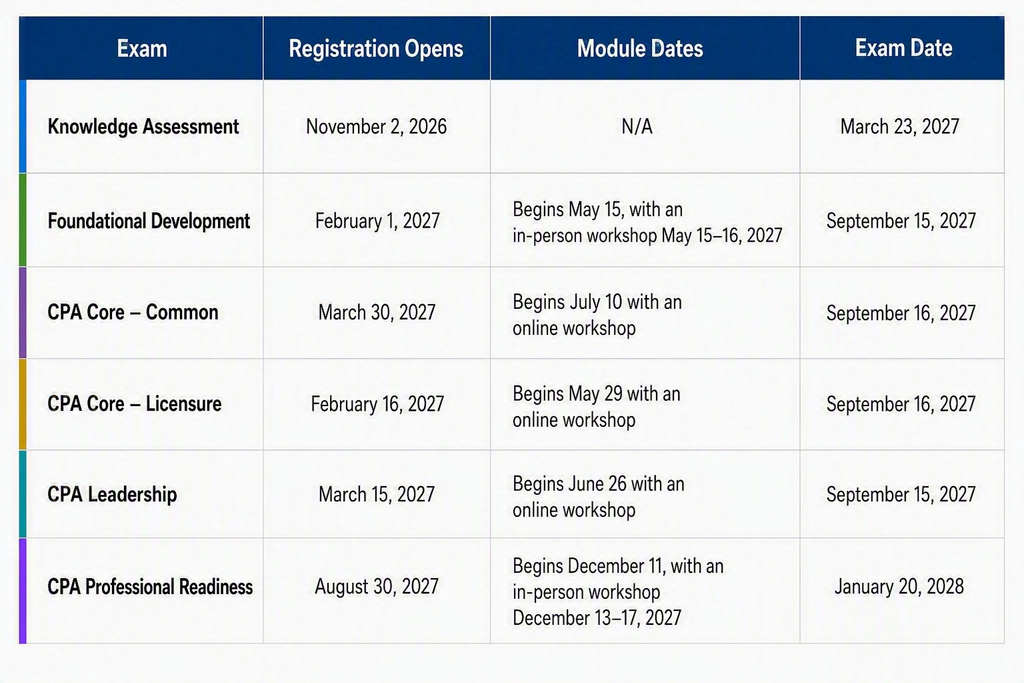
The dates below reflect CPA’s currently published 2027–2028 schedule for the first time the exam is offered. All dates are tentative and subject to change without notice as the new CPA Professional Program is finalized. Candidates should confirm current dates with their provincial or regional CPA body before making plans.
Next Steps
Densmore will be developing resources specifically designed to help candidates prepare for the new CPA Professional Program exams. Stay tuned for more information, exam prep insights, and resources as they become available at Densmore CPA Professional Program.